Live · up to 30 players

Noillirk

Seven survey prompts, and the crowd decides the score

Noillirk asks survey-style prompts and scores you on how many other players landed on the same answer. Seven prompts, twenty seconds each, and the most common reply climbs furthest.

  • 01Seven survey prompts per game
  • 02Twenty seconds to answer each
  • 03Common answers climb the board
  • 04Live rooms for up to 30 players
01

The obvious answer is the correct answer

Every other quiz trains you to reach past your first idea. Noillirk asks you to trust it, because the first idea is usually the one the room shared.

The skill is estimating other people, not outsmarting them.

Noillirk game@noillirk

What a Noillirk prompt looks like

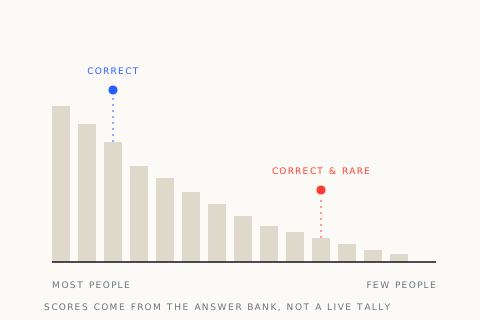
A prompt names a situation and asks for the first thing that fits it, in the way a street survey would. There is no single factual answer; there is a distribution. Your reply is compared against everyone else's in the room and scored by how far up that distribution it sits.
A survey prompt with answers stacked by how often they were chosen
Noillirk game@noillirk

Twenty seconds is a gut-check, not a search

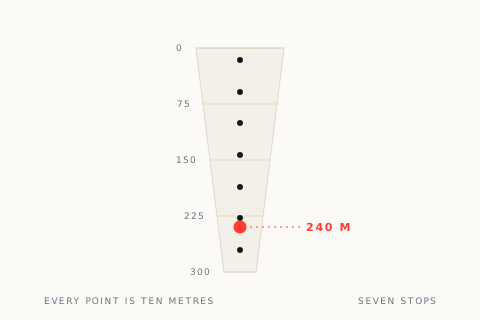
The timer is short on purpose. In twenty seconds you cannot poll the room, check a reference or reconsider twice. What you type is what came to mind, which is exactly the data the game is measuring.

A twenty-second countdown over a single answer field
Noillirk game@noillirk

Why common answers rank higher

Scoring follows frequency. If half the room names the same thing, that answer is worth the most, and a clever reply nobody matched is worth almost nothing. The board rewards a read on the crowd rather than originality, which is the opposite of most trivia formats.

A ranking ladder where the most repeated answer sits at the top
Noillirk game@noillirk

Rooms of thirty change the read

A larger room smooths out individual oddities. With thirty players, an answer that looks strange in a group of five can turn out to be the majority. That makes room size part of the game: the bigger the room, the more the result reflects a general instinct rather than a private joke.

Thirty answer cards consolidated into three frequency bands
02

What the game hands you

Survey prompts, a short clock and a room to compare against.

01

Seven prompts per round

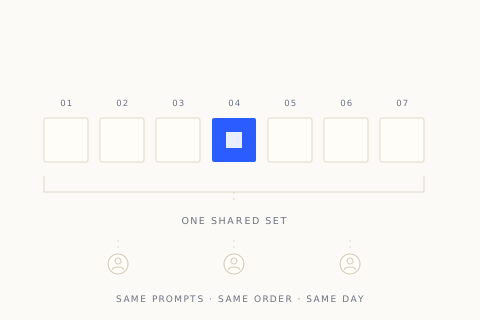
A round is fixed at seven questions, so one lucky read cannot carry the whole score. Each prompt contributes its own share.

02

Twenty seconds each

The clock is short enough that second-guessing costs you the slot. Answers are locked when the timer ends, whether or not you typed.

03

Live rooms up to thirty

Frequency is measured against the players in your room. Bigger rooms produce steadier results and fewer surprise leaders.

04

Scoring by match, not by truth

There is no answer key. Your score comes from how many others wrote the same thing, which means the room defines what counts.

03

Playing a round

Three steps, seven times over.

  1. Join a survey room

    Join up to twenty-nine other players. Everyone receives the same seven prompts in the same order.

  2. Answer within twenty seconds

    Type the first thing that fits the prompt. Deliberating usually moves you away from the answer the room will give.

  3. See how the room split

    After each prompt the game shows the most common replies and what your match was worth. The round total is the sum of seven reads.

04

Playing the crowd

Three players on the shift in thinking.

My first round went badly because I kept trying to be interesting. Once I started answering like a tired person filling in a survey, my score doubled.
JWJonas W.Plays in a full room
Thirty people makes it feel like a real poll. In a small room the answers are scattered and the result feels random.
EDElif D.Plays with colleagues
It took three rounds to stop reaching for the clever answer. The game only works once you accept that the room is the answer key.
MHMarcus H.Long-time trivia player
05

Noillirk questions

How a survey round is scored.

Seven prompts, one instinct

Answer fast, answer plainly, and find out whether your first thought matches the room's.

Answer the survey